
NAAD YOGA
The yoga of sound. The discipline of listening.

WHAT IS NAAD YOGA
Naad Yoga is the yoga of sound. It is a discipline in which sound becomes the path to self-understanding, awareness, and union.
Naad, in this tradition, refers not to music as performance or sound as sensation, but to vibration as the medium through which the self comes into contact with what is real.
Naad Yoga asks not that you perform, but that you listen and express. It belongs to one of the world’s oldest living traditions.
Different Pathways to Learn
Yogi of Sound
Raj Academy
A LIVING TRADITION
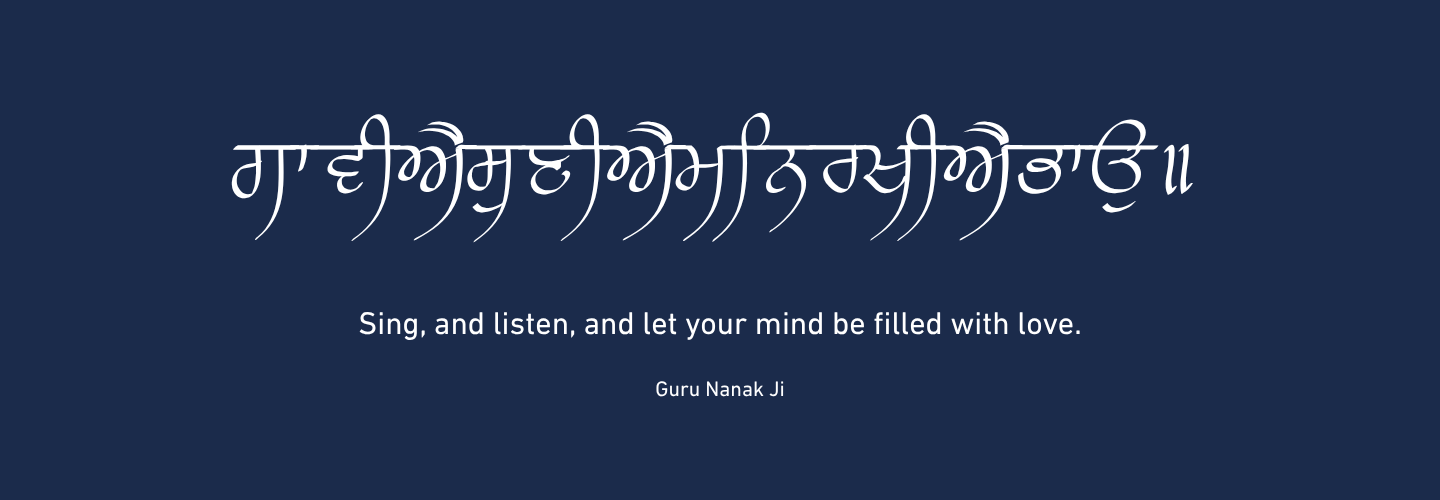
It begins with Guru Nanak, whose life and teaching were inseparable from sound. The Gurus who followed him deepened that understanding across generations, embedding it in Gurbaani — not as scripture to be recited, but as lived experience to be entered.
The tradition has been carried forward across centuries by teachers and practitioners committed to living its principles, not merely transmitting its content. It has moved through communities, across continents, and through times of both flourishing and loss.
The Council exists within that continuing stream.
It does not own the tradition. It serves it.
Professor Surinder Singh has played a formative role in shaping the Council’s understanding and stewardship of Naad Yoga. His decades of practice, teaching, and scholarship have made him one of the tradition’s most significant contemporary voices. The Council is grateful to carry its work in the light of his guidance.
The tradition continues not only through books or institutions, but through relationship. Person to person. Practice to practice. Generation to generation.
A living tradition is not inherited once. It is entrusted anew in every generation.
PRACTICE
Naad Yoga practice does not look the same for everyone. It deepens differently depending on where someone enters, how long they have walked the path, and what the tradition asks of them at any given time.
Listening
Not as a skill to be acquired, but as a capacity to be cultivated. To hear what is beneath the surface of sound. To be present to what is actually happening rather than what you expect to hear.
Voice
The human voice as instrument. Not to perform, but to discover. The voice reveals what the mind conceals. In this tradition, to unfold the voice is to unfold the self.
Breath
The ground of all sound. Breath is the first and last instrument. Its relationship to sound, to silence, and to attention is at the centre of Naad Yoga practice.
Instruments
Naad Yoga can be practiced with any instrument. The teaching within this tradition, carried by teachers trained through Raj Academy, is rooted in the instruments of the Sikh tradition — particularly the Dilruba, which is understood as an extension of the voice. Its sound is built to mirror the human vocal range, and learning to play it changes how the voice is heard and produced. The Rabab, Saranda, Sarangi, Taus, and Jori each carry their own place within this living tradition.
Gurbaani
The compositions of the Sikh Gurus form the primary textual and sonic body of Naad Yoga as practiced within this tradition. Gurbaani is not recited here. It is entered. Its raags — there are 60 in the Guru Granth Sahib — are understood as emotional states, each one a distinct landscape of human experience.
Silence
Perhaps the most demanding practice of all. The tradition understands silence not as the absence of sound but as its completion. What is heard in silence is what the practice has been preparing you to hear.
Community
The tradition has always understood that knowledge is transmitted through relationship. Teaching others is itself a form of deepening. The Sangat — the community of practitioners — is not a support structure for the practice. It is part of the practice.
None of this is meant to be done alone.
Listening
Voice
Breath
Instruments
Gurbaani
Silence
Community
FREQUENTLY ASKED QUESTIONS
Is Naad Yoga a religion?
No. The tradition is rooted in the Sikh Gurus and draws its primary texts from Gurbaani, but Naad Yoga is a practice open to anyone, regardless of faith or background. What it asks is not belief, but attention.
Can anyone practice?
Yes. Naad Yoga requires no prior musical training, no yoga background, and no particular spiritual framework. It asks only a willingness to listen and a commitment to practice.
Do I need music training?
No. You will develop musical understanding through practice. What you bring at the beginning is less important than what you are willing to become.
Is this therapy?
Naad Yoga is not a therapeutic modality. It does not treat conditions or diagnose states. It is a discipline — one that, practiced with integrity over time, tends to bring greater clarity, coherence, and presence. But those are outcomes of the practice, not its goal.
What instruments are used?
Naad Yoga can be practised with any instrument. The teaching within this tradition, carried by teachers trained through Raj Academy, is rooted in the instruments of the Sikh tradition — particularly the Dilruba, which is understood as an extension of the voice. The Rabab, Saranda, Sarangi, Taus, and Jori each carry their own place within this living tradition.
What is the role of Gurbaani?
The sacred compositions of the Sikh Gurus form the primary textual and sonic body of Naad Yoga as practised within this tradition. Gurbani is not recited here. It is entered. Its raags — there are 60 in the Guru Granth Sahib — are understood as emotional states, each one a distinct landscape of human experience.
What makes Naad Yoga different from sound healing?
Sound healing typically uses sound as a tool applied to the listener from the outside. Naad Yoga asks the practitioner to become the instrument. The distinction is not therapeutic versus non-therapeutic. It is passive versus participatory. In Naad Yoga, you are not treated.
You practice.
Naad Yoga is not something to admire from a distance.
It is something to live.
The tradition asks for time. It asks for consistency. It asks for the kind of attention that cannot be hurried. And it gives back, across years of practice, something that is difficult to name and impossible to replicate through any other means.
If you are drawn to it, that is enough to begin.